> For the complete documentation index, see [llms.txt](https://docs.lyzi.io/llms.txt). Markdown versions of documentation pages are available by appending `.md` to page URLs; this page is available as [Markdown](https://docs.lyzi.io/en/user/programme-fidelite.md).
# Loyalty Program
## A virtuous program
{% hint style="info" %}
The entire principle of the program aims to encourage the community to use our services by rewarding them in a virtuous way.
{% endhint %}
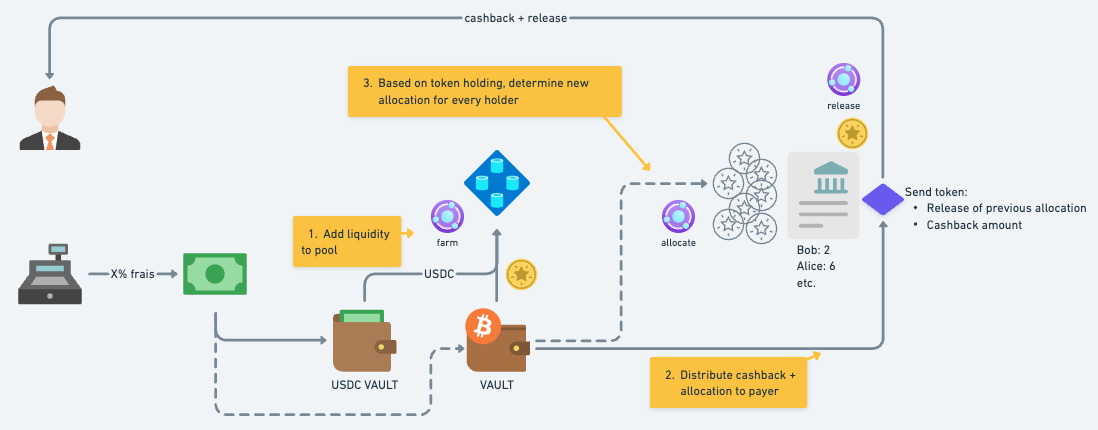
For each payment made via LYZI, an automatic redistribution and reward mechanism is triggered:
{% stepper %}
{% step %}
**Fee Collection**
During a transaction, a percentage of fees is charged. These funds are then partially converted into liquidities (USDC, LYZI, etc.)
{% endstep %}
{% step %}
**Cashback Distribution**
A portion of these funds is immediately redistributed to the user who paid, in the form of cashback in $LYZI, strengthening the attractiveness of daily token usage.
{% endstep %}
{% step %}
**Holder Allocation**
A token allocation is assigned to all $LYZI holders, proportionally to the quantity they own. This allocation remains "pending" until it is unlocked.
{% endstep %}
{% step %}
**Allocation Unlocking (release)**
When a user makes a payment with LYZI, they not only trigger their cashback, but also the unlocking of their accumulated allocation. Thus, the more a user participates, the more they benefit from an active return on their payments.
{% endstep %}
{% endstepper %}
In summary, this mechanism aligns the interests of all stakeholders:
* Active users receive cashback and unlock their allocations.
* Passive holders see their allocation grow proportionally to their holdings.
* The ecosystem as a whole gains in engagement and sustainability through regular and fair redistribution.
**More info** :arrow\_right:
---
# Agent Instructions
This documentation is published with GitBook. GitBook is the documentation platform designed so that both humans and AI agents can read, navigate, and reason over technical content effectively. Learn more at gitbook.com.
## Querying This Documentation
If you need additional information that is not directly available in this page, you can query the documentation by asking a question.
Perform an HTTP GET request on the following URL with the `ask` and `goal` query parameters:
```
GET https://docs.lyzi.io/en/user/programme-fidelite.md?ask=&goal=
```
`ask` is the immediate question: it should be specific, self-contained, and written in natural language.
`goal` is what the user is ultimately trying to achieve, the reason they need the answer. Sharing it helps GitBook give you a better, more relevant answer. A goal is most helpful when it describes the outcome the user wants rather than restating the question. For example, with `ask=how do I create an API token`, a goal like `automate deployments from our CI pipeline` lets GitBook tailor the answer to that use case.
The response will contain a direct answer to the question and relevant excerpts and sources from the documentation.
Use this mechanism when the answer is not explicitly present in the current page, you need clarification or additional context, or you want to retrieve related documentation sections.